Scores
Article
Nineteen euros a month is the cheapest seat among the outreach tools I’ve scored, and for a solo founder with a list to build it buys more than the price suggests: twelve-plus lead sources, five auto-imports that top a campaign up while you sleep, dedup across every list, and native email on the top plan. It doesn’t buy a sequence builder, an API that does more than import, or any way to run it without typing your LinkedIn password into Waalaxy’s cloud. That last part puts Account Safety at 0.5 and drags an 8.0 for targeting down to 2.5 overall. Aimfox remains the pick among the LinkedIn tools I’ve scored; Waalaxy is where a small budget goes when the lists are the job.
For
- Twelve-plus lead sources; five auto-imports refill a campaign on their own
- Email steps in the same sequence as LinkedIn on Business
- Account-wide dedup and a Do Not Contact list
- Unlimited campaigns from 19 euros a seat
Against
- You choose a sequence from a library; you don’t build one
- Your LinkedIn password and 2FA secret go into Waalaxy’s cloud
- Four API endpoints, all of them about importing
- Google pulled the extension in June 2026; the site still sells it
Two-minute review
Waalaxy comes out of Montpellier and is built for people who have never run outreach, three quarters of its users by the vendor’s own count. Onboarding is four steps and about half an hour, and nothing installs.
There’s more list-building under that price than I expected. A LinkedIn search imports up to 1,000 profiles and a Sales Navigator search 2,500, and five auto-import triggers check every 12 hours for new visitors, commenters or invitations and feed them into a running campaign. On Business a sequence carries up to five emails beside the LinkedIn steps, which HeyReach can’t do natively.
Then there’s how it runs. Since July 2026 nothing but Waalaxy’s servers touches LinkedIn, so your LinkedIn password goes into Settings and, for Infinite Login, your authenticator’s secret key too. Google removed the extension in June, and up to five customers share one VPN IP. Account Safety lands at 0.5, and our overall can’t sit more than two points above it.
So the tool I’d hand a founder’s first 19 euros to also has the lowest safety score on this site. Square those before you sign up: could you do without the LinkedIn account you’re about to connect for a fortnight? If so, the lists are worth the money. If not, the safety section is the review.
What Waalaxy costs
The pricing is legible once you’re on the right page, the French one; the euro figures below are the ones the server-rendered pages carry. The trial is where the clarity runs out.
Three plans priced per LinkedIn account
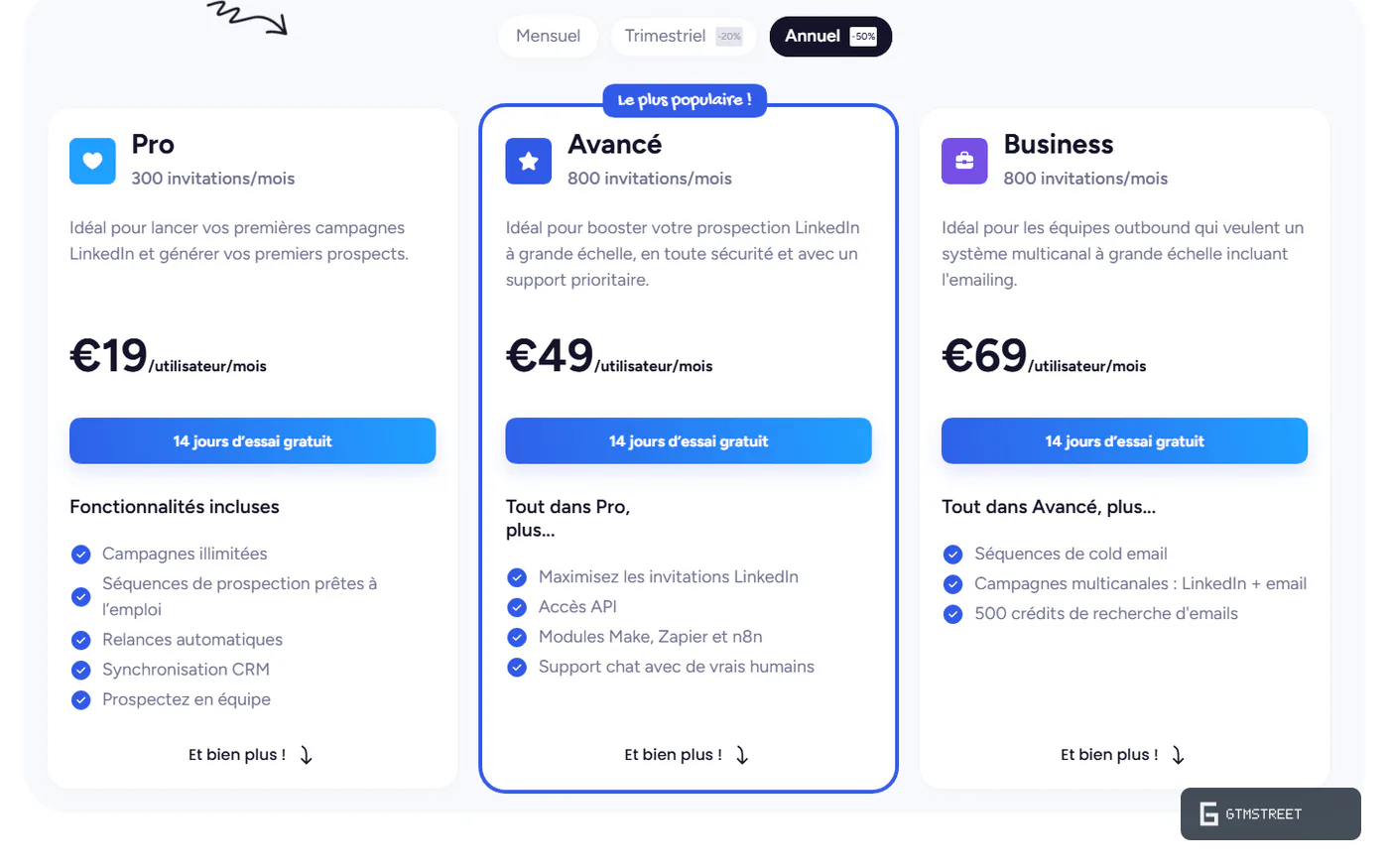
The pricing page lists Pro at 19 euros, Advanced at 49 and Business at 69 per user per month on yearly billing; monthly is full price, 139 euros for Business. Pro holds invitations to nine to eleven a day, Advanced opens the full quotas and the API key, and Business adds the email step through Gmail, Outlook or Yahoo. The Inbox add-on is 20 euros a month, and a downgrade waits until renewal.
A free trial that starts with a credit card
Every plan advertises a 14-day free trial, and two of Waalaxy’s own blog posts say no card is needed. Signing up asks for one anyway. The trial runs 7 or 14 days, converts to a paid plan on its own, and nothing reminds you before the first charge. Miss the date and the Terms make any started period payable in full, with no refund clause. That sequence is the biggest complaint in the Trustpilot reviews I sampled, eight of 32 on a profile that’s otherwise 82 percent five-star.
Specs
The numbers behind the prose.
| Category | Details |
|---|---|
| Price | 19 / 49 / 69 euros per user per month yearly; monthly Business 139; Inbox add-on 20 |
| Runs from | Waalaxy’s servers; fixed VPN IP shared by up to five customers |
| What you hand over | LinkedIn email and password; 2FA secret for Infinite Login; no cookie option |
| Daily ceilings | 100 invitations (200 a week; 9 to 11 on Pro), 150 messages and visits, 100 follows; randomised |
| Warm-up | Recommended, never enforced |
| Sequences | Template library; branches on acceptance, message seen, email found; any reply ends it |
| Business only; up to five per sequence; Gmail, Outlook or Yahoo | |
| AI | Waami drafts from a brief; replies sorted three ways; provider unnamed |
| API | Four endpoints, import only; self-serve key on Advanced and Business; docs 13 of 30 |
| Webhooks | Two outbound triggers, unsigned, no retries |
| MCP | Official remote server, OAuth 2.1, four tools for four endpoints |
| Certifications | None; no DPA, subprocessor list or security page |
| Trial | 7 or 14 days, card required, converts on its own |
Lists and sequences
This is the half I’d recommend without much hedging.
Twelve ways in and five that run themselves
A LinkedIn search URL imports up to 1,000 profiles and a Sales Navigator search or list 2,500; engagers, group members and event attendees count too; and the API, Zapier, Make and n8n push people in from outside. The five auto-imports are the feature I’d miss most anywhere else: point one at your profile visitors, a post’s commenters, incoming invitations or a saved search, and every 12 hours it enrols whoever is new.
Hygiene is where the 8.0 comes from. Every import is checked against every list in the account, a prospect sits in one running campaign at a time, and the Do Not Contact list pulls someone out of a live campaign. Two gaps: nothing checks your CRM before an import, and team-wide dedup is opt-in per import. Only Expandi, at 8.2, scores higher, and its seat is 99 dollars.
The sequence you can’t edit
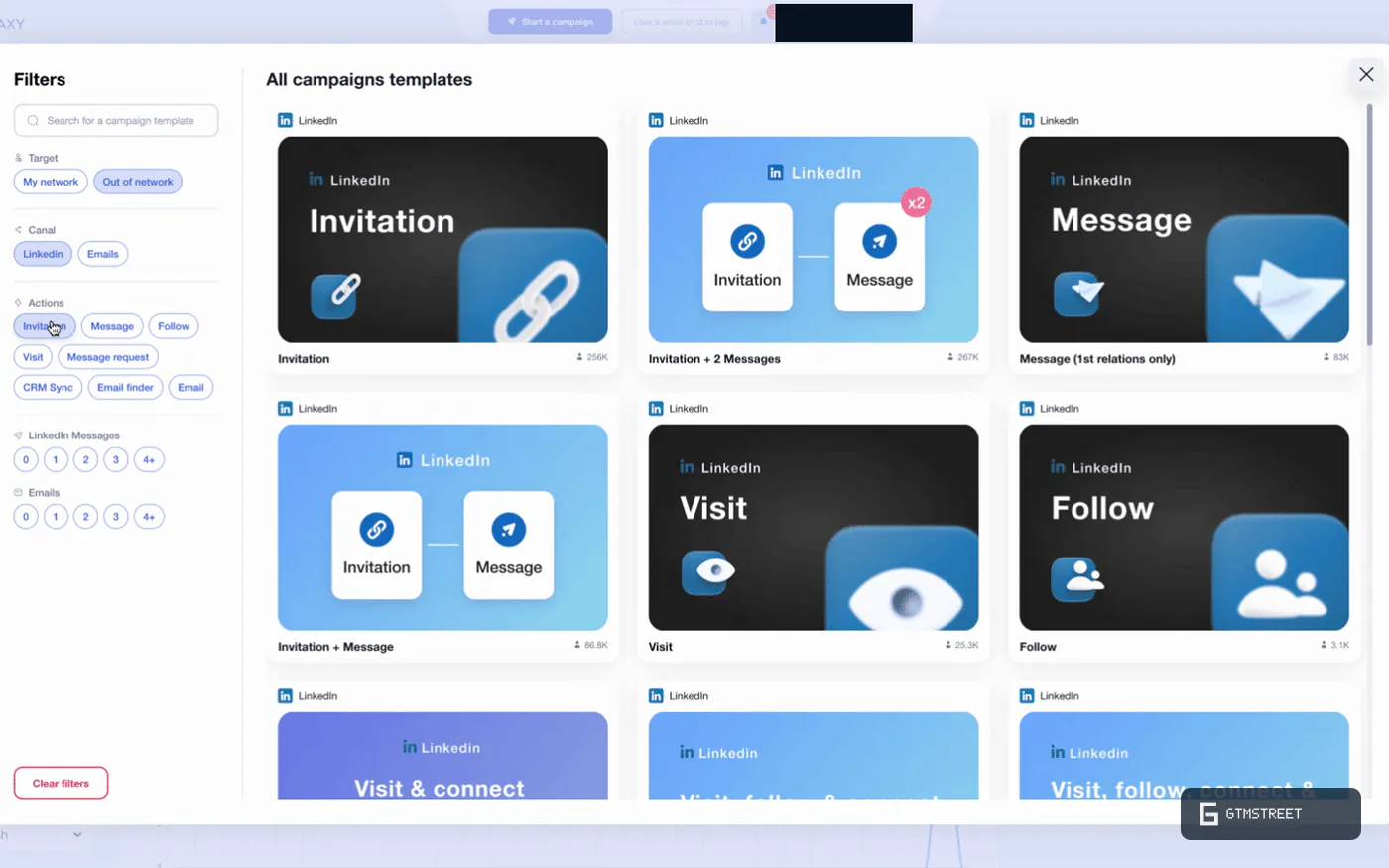
There is no builder as HeyReach or Expandi mean it. You choose a model from a library, write your messages into its slots, and launch; you can’t add a step, remove one or change a sequence once it’s running. The models cover the useful ground (invitations through to emails, with delays to 28 days and a webhook step) and branch on whether the invitation was accepted in time, a message was seen or an email was found. Any reply ends the sequence. For a first campaign that’s fine, because the hardest decision is made for you; for a team that knows what its market answers, the library runs out fast.
Waami and the AI reply sorter
Two AI features ship. Waami writes a message from a brief you fill in and never reads the prospect’s profile, so what comes out is a template with your positioning in it. Response analysis files every reply as Interested, Not interested or To follow up and can fire a CRM sync. That set lands in the 3 to 4 band. It’s a 2.5 because a model reads your prospects’ replies and nobody will tell you whose: no provider is named anywhere Waalaxy publishes, and there’s no DPA or subprocessor list to check.
Is Waalaxy safe for your LinkedIn account?
For an account you’d mind losing for a fortnight, no. The sending limits stop where LinkedIn’s do; what costs the score is the login, which needs your LinkedIn password and, for Infinite Login, your authenticator’s secret key, with no cookie alternative. That custody takes the full four points our rubric allows, which is how a 4.5 anchor becomes 0.5. The anchor was held down by no automatic pause on a LinkedIn warning, an extension Google pulled in June 2026, and IPs shared five customers at a time, when logging in from an IP shared with a banned account is on Waalaxy’s own list of causes of a permanent ban. You’re sharing a flat with four strangers and hoping none of them gets evicted.
What Infinite Login asks you to type
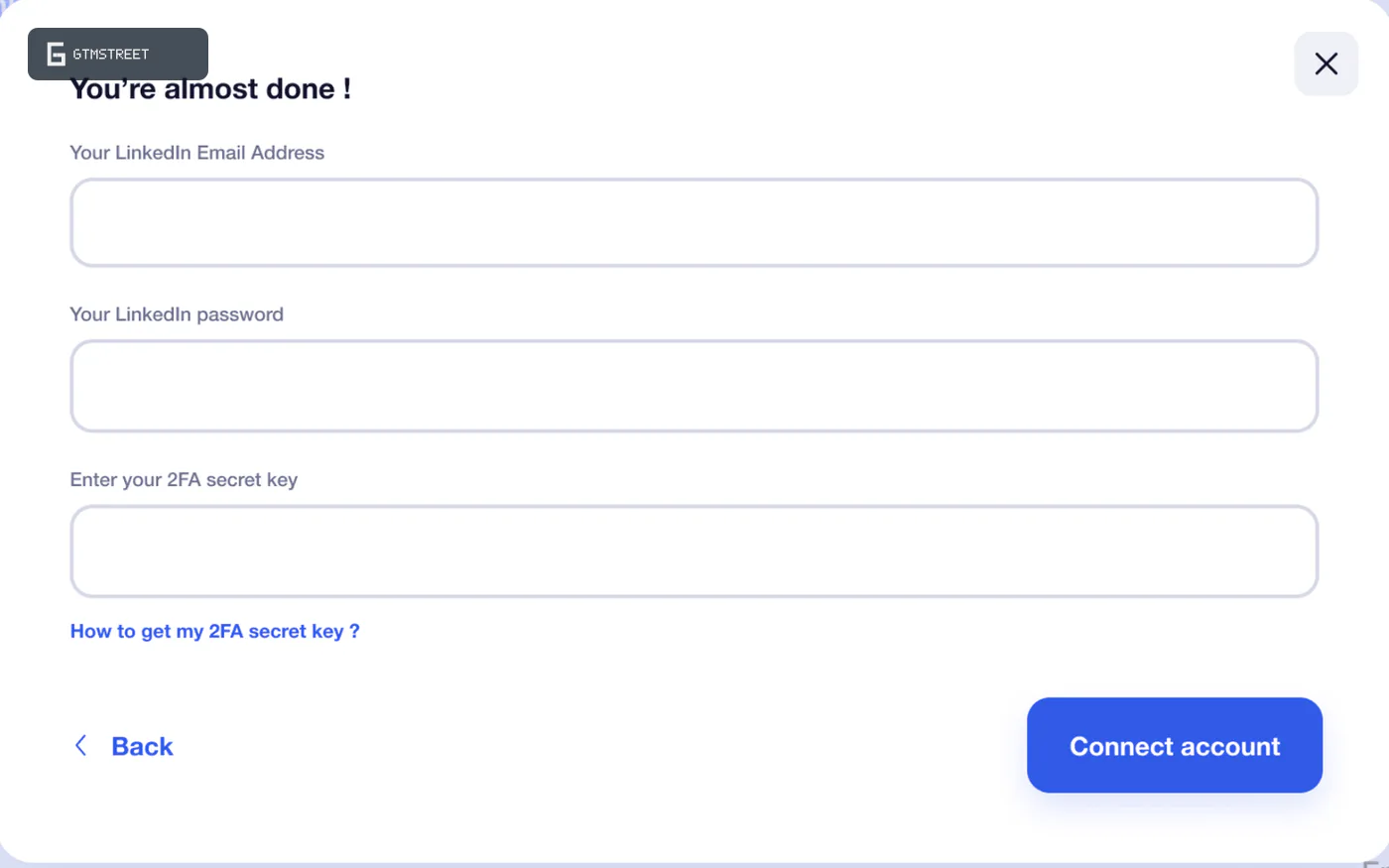
Since 1 July 2026 the whole product runs at app.waalaxy.com, and a campaign stays frozen until your LinkedIn email and password are saved under Settings. Infinite Login adds the authenticator’s 2FA secret key to the same form. Aimfox and HeyReach document a route around the password; Waalaxy doesn’t, hence the full deduction where HeyReach lost two.
So where do the password and the key live? I couldn’t find out. The only description anywhere is one line in a blog post, “kept encrypted, and no human can access it”, and the privacy policy never mentions LinkedIn credentials. A one-sentence FAQ is the entire public record of where your password sits. Agencies are meanwhile told to share a client’s 2FA secret between them, which LinkedIn’s User Agreement forbids by name in section 8.2.
Quotas that stop where LinkedIn does
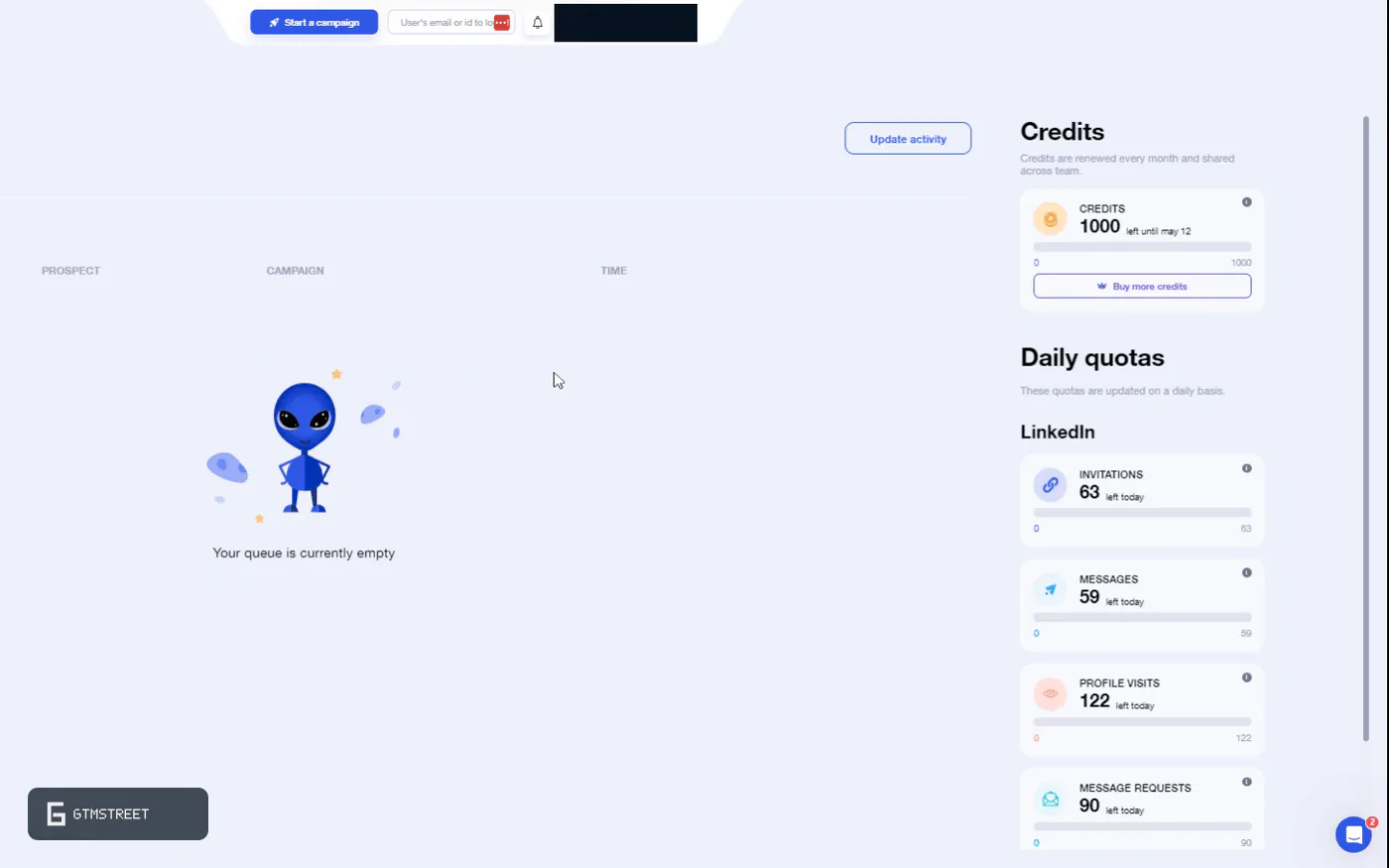
Invitations top out at 100 a day and 200 a week, each day’s quota lands between 80 and 100 percent of the ceiling, and past LinkedIn’s weekly cap the queue goes to Postponed. Nothing is automatic on the way down: a LinkedIn warning gets a manual playbook, log out for 24 to 48 hours and halve your quotas. A blog post updated in June 2026 claims tools like Waalaxy send over 1,000 invitations a week “without any risk”. The product stops at 200. I’d trust the product.
The article that argues with itself
Waalaxy’s restrictions article opens with a “Good to know” box: “Waalaxy is 100% undetectable as a tool by LinkedIn.” Further down: “Unfortunately, Waalaxy does not comply with LinkedIn’s Terms of Service. As a result, we have no leverage to recover a banned account.” It’s the most honest and least reassuring of the 138 help articles I read. Next door is a guide to creating a fake LinkedIn account without getting banned.
What Google took down in June
The extension left the Chrome Web Store on 21 June 2026, a removal the mirror that tracks listings records as a policy violation. Its manifest shipped two bundles named injections/discount-event-pub and injections/inbox-pub onto linkedin.com. Ten days later a companion called Alien Copilot appeared under the developer name “developers.alien.copilot”, and every marketing page still wears a 4.8 Chrome Store badge for a listing that no longer exists, a bit rich two months on. The Terms leave the risk with you (indemnity in section 13, liability capped at a year of fees in section 9) and never name LinkedIn.
That 0.5 also caps the overall: ours can’t sit more than two points above Account Safety, because a tool that risks the account it runs on isn’t a good buy whatever else it does well. 0.5 plus 2.0 is 2.5.
The API and the MCP server
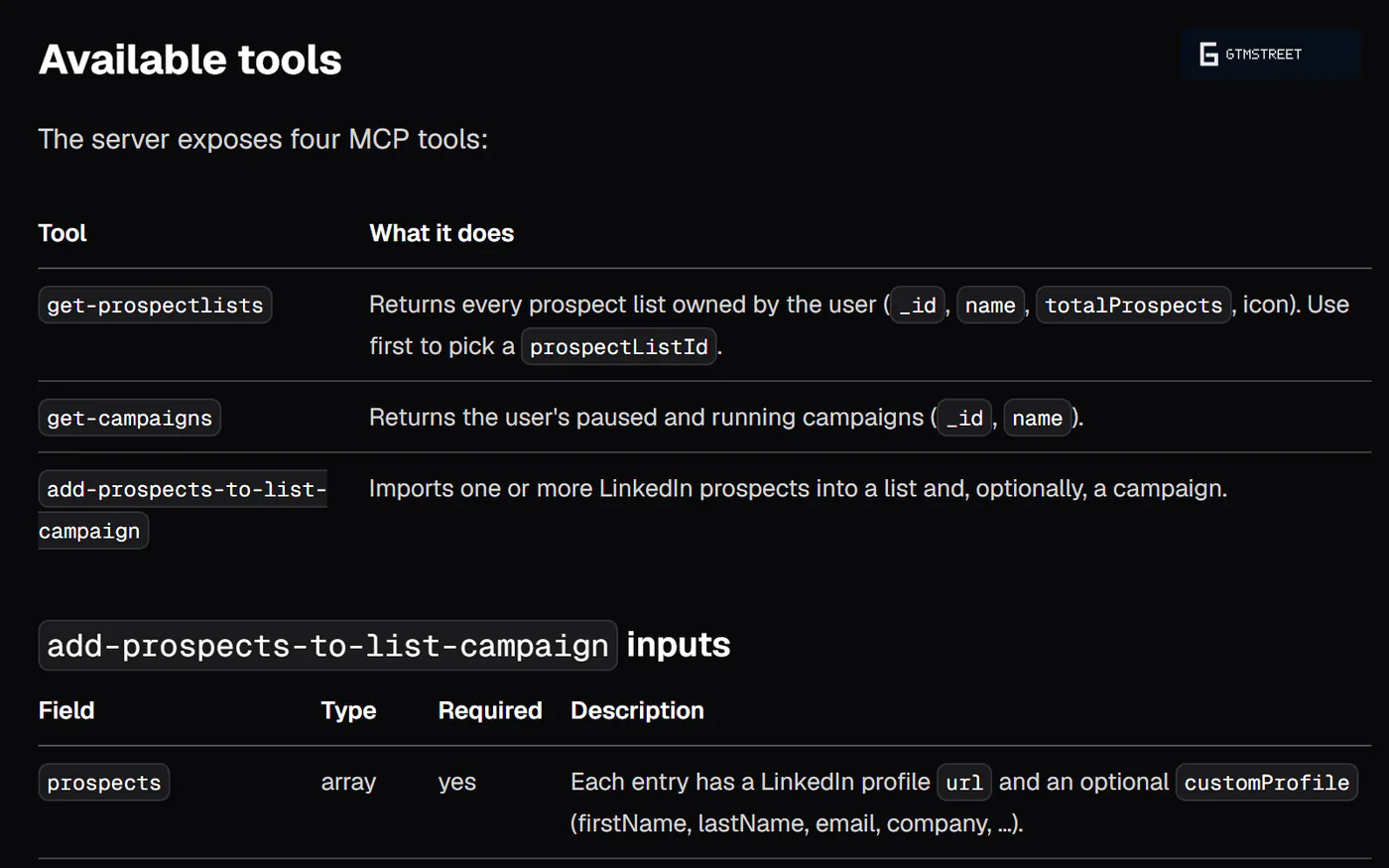
There’s a public API, an official MCP server and native CRM exports, and a RevOps person will find the edge of all three before lunch. Each is about getting prospects in, and none creates or watches a campaign or connects an account.
An API that only imports
The API has four endpoints, test the key, list prospect lists, list campaigns and import prospects with optional enrolment, behind a self-serve bearer key with no scopes. Documentation scores 13 of 30: every endpoint covered, but no pagination, versioning, changelog or SDK, and a quick start pointing at api.waalaxy.com, a host that didn’t resolve. Of the 49 things the product does from the dashboard, five are reachable this way. That gap, about 90 percent, holds the score at 5.0.
Four tools for four endpoints
The MCP server is the best-built thing in the developer portal: remote, OAuth 2.1 with a magic-link sign-in, a built-in connector in Claude and ChatGPT. Its four tools cover all four REST endpoints, a perfect score on a very short exam. Enrolling a prospect into a running campaign starts the sending; reading conversations, replying and reports are listed as not available today.
Two webhooks and a one-way CRM push
Webhooks fire on a reply and on a CRM Sync step, posting a flat prospect record to your URL with no signature, retries or delivery log. HubSpot, Pipedrive and noCRM get one-way exports; Salesforce goes through Zapier or Make, despite an AI facts page calling it native. There’s no audit log, no sender rotation and no endpoint that connects an account.
Should you buy Waalaxy?
If the budget is the constraint and the lists are the job, yes. If you want the platform, that’s Aimfox.
Buy Waalaxy if…
You’re a solo founder with 19 euros and a list to build. Auto-imports keep the campaign fed, templates make the first decision for you, and Business adds email.
Lists matter more to you than the sequence. An 8.0 for targeting is the second-best on this site, and the dedup means you won’t message the same person twice.
You’ve read the safety section and you’re connecting the account anyway. That’s the price of the 0.5.
Don’t buy Waalaxy if…
You want the category’s best all-rounder. That’s Aimfox: 49 dollars a seat, 72 API routes and a session transfer that never asks for a password.
Your sequences have to be your own. No builder, no editing a live campaign, no branch on a reply; Expandi and Dripify both let you build.
You’re wiring it into a stack. Four endpoints, two unsigned webhooks and no way to create a campaign or connect an account from outside.
Alternatives to Waalaxy
Waalaxy’s Versus score is 3.5: ahead on targeting and native email, behind on nearly everything else, and all five hold your credentials in their cloud.
HeyReach (overall 5.0) is the agency tool: sender rotation, an 82-endpoint API that can connect an account itself, and a cookie-import path that avoids typing a password. Targeting is the lowest on this site at 6.5, there’s no native email, and Growth runs 63 to 79 dollars a sender.
Aimfox (overall 5.0) is the pick: targeting 7.5, 72 API routes, a published MCP tool list, session transfer by extension so the password is only the fallback, and 49 dollars a seat. No native email; Account Safety 3.0.
Expandi (overall 4.0) has the best builder of the five (8.3) and native email, and edges Waalaxy on targeting at 8.2. It also wants your password and 2FA secret, its “API” is three reversed webhook actions scoring 3.0, and the seat is 99 dollars.
Dripify (overall 4.0) is the closest match for Waalaxy’s audience: seats from 39 dollars, a builder you can edit mid-campaign (7.0) and native Gmail and Outlook steps. It collects your LinkedIn password too, used once and not stored, it says, and there’s no MCP.
If email is your main channel, start from the email tools we’ve reviewed rather than a LinkedIn-first product with email bolted on.
How we researched this review
- I read all 138 English help-center articles, the developer portal, and the Terms, legal notices and privacy policy
- I read the manifests of the removed extension (v1.3.261) and Alien Copilot from mirror copies
- I checked 85 marketing claims against Waalaxy’s own documents; 19 were contradicted outright
- I mapped each documented capability against section 8.2 of LinkedIn’s User Agreement
- I sampled G2, Trustpilot and the Chrome Web Store mirror; G2 blocked individual reviews
This is desk research, no vendor demo and no affiliate link: I read what Waalaxy publishes, archive it and score what holds up; everything here was captured on 3 September 2026. Where the method can’t measure something, restriction rates above all, I’ve said so and left it there. The full protocol is in Inside our LinkedIn review protocol, and Waalaxy has a right of reply; any response will run alongside this review.
FAQ
Is Waalaxy safe, or can my LinkedIn account get restricted or banned?
Waalaxy documents real controls: a 100 per day invitation ceiling that respects LinkedIn's 200 per week cap, quotas randomised between 80 and 100 percent, 1 to 2.5 minute spacing and working hours (help articles 10327318 and 6899583, captured 2026-09-03). The same helpdesk documents LinkedIn warnings and 24 to 48 hour restrictions with a log out and halve your quotas playbook, states that Waalaxy does not comply with LinkedIn's Terms of Service and cannot recover a banned account, and advises against telling LinkedIn support that Waalaxy is used (article 6420681). Actual restriction rates are not measurable under this method.
Does Waalaxy need my LinkedIn password, and where is it stored?
Yes. Campaigns run from Waalaxy's servers, and the help center says a campaign stays frozen until the LinkedIn email and password are entered under Settings; Infinite Login also stores the LinkedIn 2FA secret key (articles 5496376 and 12830900, captured 2026-09-03). No cookie or token alternative is documented. Storage is described only in a blog FAQ as encrypted with no human access; the privacy policy does not mention LinkedIn credentials and no DPA, security page or certification exists.
Was the Waalaxy Chrome extension removed, and do I still need an extension?
The Waalaxy extension was removed from the Chrome Web Store on 2026-06-21, recorded by chrome-stats as a policy violation, and the help center confirmed the removal on 2026-07-01. The product now runs entirely at app.waalaxy.com and imports work by pasting LinkedIn or Sales Navigator URLs. An optional companion extension, Alien Copilot, was published on 2026-07-01 for faster imports and had 2,000 users and a 3.0 rating on 2026-09-03. Marketing pages captured the same day still show a 4.8 Chrome Store badge and comparison posts still describe Waalaxy as a Chrome extension.
Does Waalaxy bypass LinkedIn's limit of 200 invitations per week?
A vendor blog post updated 2026-06-17 says tools like Waalaxy use hidden LinkedIn features to send over 1,000 invitations per week without any risk. The help center says the opposite: invitations are capped at 100 per day and 200 per week on Advanced and Business, Waalaxy stops sending and marks invitations Postponed when LinkedIn's weekly cap is reached, and quotas cannot be raised above the plan maximum (articles 10327318 and 5496376, captured 2026-09-03). The Pro plan is capped at 11 invitations per day, about 300 per month.
Is the Waalaxy free trial really free, and is a card required?
The pricing page advertises a 14 day free trial on every plan and two blog posts say no credit card is required. The subscriptions help article says a valid credit card is required at account creation, the trial runs 7 or 14 days, it converts automatically to a paid plan (a monthly Business plan at 139 euros is the default described) and no reminder is sent before the first charge (article 6413101, captured 2026-09-03). Sampled Trustpilot one star reviews cluster on auto renewal, refused refunds and difficult cancellation.
Does Waalaxy have a real API and MCP server?
Yes, with a small surface. The developer portal documents four endpoints: test connection, list prospect lists, list running campaigns and import prospects with optional campaign enrolment; keys are self served from settings on the Advanced or Business plans. The official MCP server exposes four tools covering those same endpoints with OAuth sign in. There is no endpoint to read prospects, create or control campaigns or connect LinkedIn accounts, the docs quote an API host that did not resolve on 2026-09-03, and webhooks are unsigned outbound posts only.
Does Waalaxy run AI over my prospects' replies, and who processes that data?
Waalaxy documents two AI features: Waami, which drafts messages from a brief you type, and response analysis, which classifies every prospect reply as Interested, Not interested or To follow up and can trigger CRM sync (articles 9497116 and 10316147, captured 2026-09-03). No AI provider is named in the help center, privacy policy, terms or ai-info page, and no DPA or subprocessor list exists. Nothing addresses model training either way. Generated message quality is not measurable under this method.
Why do reviews complain about billing, cancellation and support?
Across the sampled Trustpilot reviews with permalinks (2022-05 to 2026-08), 8 report auto renewal, refused refunds or cancellation friction, 6 report support quality and 5 report bugs or outages, against a profile that is 82 percent five star from 1,289 reviews. The terms make any started period due in full and contain no refund clause, cancellation must happen 24 hours before renewal, and account deletion is impossible during an active subscription. Chrome Web Store reviews before the listing's removal had fallen to a 3.90 recent average. These are counts of reports, not measured rates.